The Future of Embodied Intelligence
In 2025, we witnessed the definitive transition from Generative AI to Agentic AI. It was the first time AI moved beyond "chatting" to "doing", utilizing strong reasoning to navigate the digital world autonomously.
While 2025 was about mastering the digital world, 2026 is about mastering the physical world. The market has shifted focus from the saturation of software tools towards Physical AI. We are no longer content with agents that can merely book a flight; we need agents that can manage a global supply chain or maintain a fleet of autonomous delivery bots.
However, even the most sophisticated agent is paralyzed if it cannot interface with the high-value hardware it was meant to command. To bridge this gap, we must move beyond software-centric standards like the Model Context Protocol (MCP) and build a Physical-Digital bridge, a runtime environment that empowers agents to sense, reason, and act within the physical world.
This paper explores the technical specifications of PUDA, its integration with existing AI Agents, and its application in high-throughput industrial environments.
Abstract
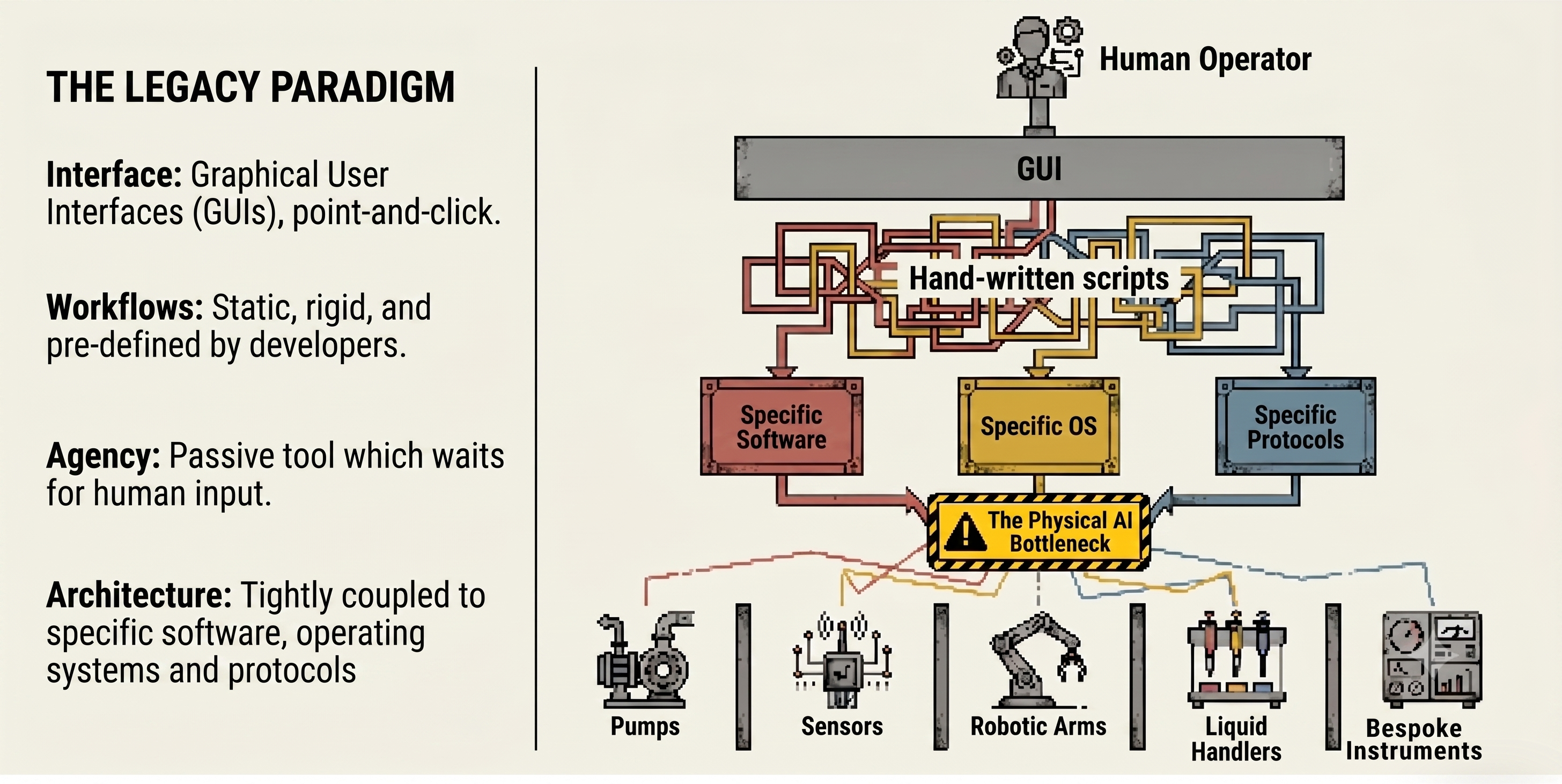
Modern laboratories, factories and real-world industrial processes increasingly rely on a heterogeneous mix of physical devices. Today, each device is typically driven by hand-written scripts that are tightly coupled to a specific vendor SDK, a specific communication protocol and a specific operating system. As AI agents become more and more capable of planning and executing complex real-world procedures, legacy fragmentation and isolated deployment becomes the central bottleneck to Physical AI.
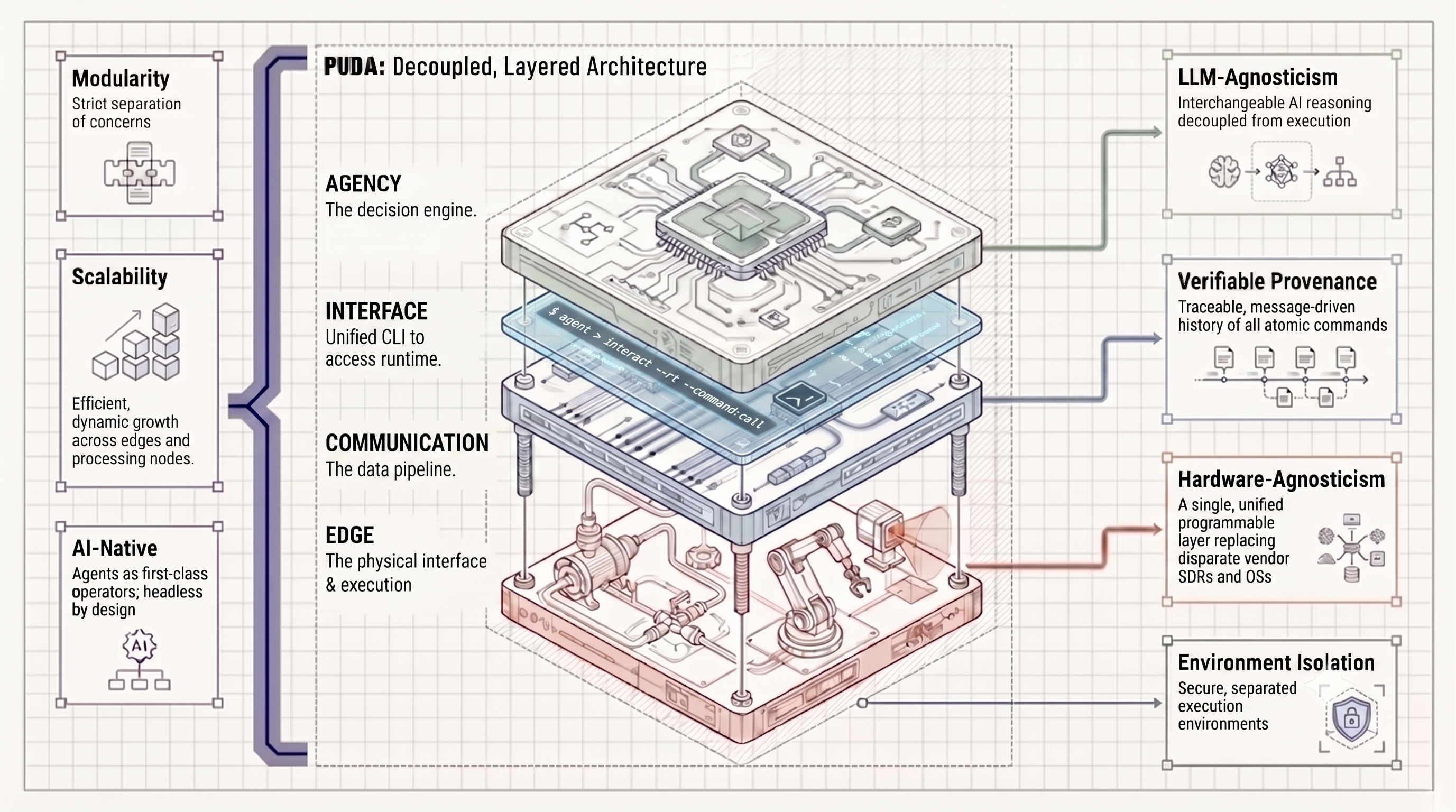
To solve this, we introduce the Physical Unified Device Architecture (PUDA): a hardware-agnostic, LLM-agnostic runtime environment designed to abstract complex hardware interfaces into a single, unified programmable layer. PUDA provides AI agents and software systems with a verifiable control plane over any physical machine, regardless of its underlying architecture.
Headless by design and message-driven at its core, PUDA shifts the paradigm by treating autonomous agents, rather than humans, as first-class operators. By decoupling high-level AI logic from low-level physical execution, PUDA eliminates the friction of hardware fragmentation, enabling seamless, scalable deployment across diverse environments.
Motivation
The software stack for Physical AI today looks roughly like this: Most machines ship with their own SDK, protocol, and quirks. Protocols are written as one-off scripts, tightly bound to a single machine. Data provenance is informal — files on a hard disk or shared drive, manually named. Agents (LLMs) are bolted on top, usually by wrapping the same brittle scripts.
This creates three problems:
- Rigid Coupling: Leading to lack of standardization and severe fragmentation.
- Weak provenance: Data produced cannot be linked to the exact commands that produced them, making reproducibility, validation and verification difficult.
- AI agents operate blindly: They lack the structured context to understand the physical machine, the environment, the underlying execution of specific commands, and the structure of the data returned.
PUDA is designed to address all three simultaneously.
Design Goals
The PUDA architecture is defined by two core principles that transform how autonomous intelligence interacts with the physical world:
- Modularity: By partitioning the stack into Agency, Interface, Communication, and Edge layers, PUDA ensures that the "brain" of the system is never hard-coded to the "nerves" and "muscles." This separation provides the foundation for hardware and LLM-agnosticism, allowing users to swap components as technology evolves.
- Scalibility: PUDA is made to scale, supporting up to 1,000,000 devices and 300,000 commands per second. Integration of a new machine designed to be straightforward and rapid, provided a good programmatic interface for the device.
- AI-Native: PUDA is built "AI-first." By providing a fully observable environment where every command generates rich telemetry, we enable agents to operate with a high degree of "situational awareness." This leads to verifiable provenance and environment isolation, ensuring that every action is logged, secure, and executed within a safe sandbox.
Architecture
The PUDA runtime environment is a microservices architecture designed for high-throughput, hardware-agnostic and agent-agnostic control. By separating the physical execution from the high-level logic, it achieves a balance of flexibility and robustness.
Communication Layer
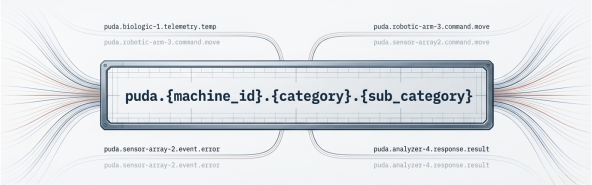
The foundation of PUDA is a high-performance messaging backbone powered by NATS. In this layer, every entity — whether a hardware machine, or a CLI tool, or a logger — operates as a first-class participant within a unique subject namespace. This message-centric design provides three core advantages:
- Loose Coupling: All clients interact via subjects rather than direct IP addresses, meaning the Agentic Layer remains oblivious to the specific location of an Edge device.
- Uniform Observability: Because every action is a discrete NATS message, the entire system state can be logged, audited, or replayed in real-time.
- Language Agnosticism: Any service that can speak NATS can join the ecosystem, this means 11 officially supported languages and 18 community contributed.
Agentic Layer
Sitting at the top of the stack, the Agentic Layer serves as the system's intelligence center. It decides what moves and when — reasoning over incoming telemetry to determine the next course of action. It contains our basic PUDA Skills, which are generic skills on how to use the PUDA CLI.
- Orchestration & Protocols: It writes protocols — declarative, high-level blueprints that define the sequence of operations required to achieve a specific outcome.
- Workflow Management: It manages the complexities of execution, including temporal sequencing, cross-device coordination, and sophisticated error recovery to ensure the fleet operates flawlessly.
- User-Defined Logic (Agent Skills): PUDA is designed for extensibility. Users can build custom workflows tailored to their specific use cases by writing their own Agent Skills, a set of pre-defined functional capabilities that the AI Agent will then use.
Interface Layer
The primary interface is the PUDA CLI, a powerful command-line tool through which agents and users alike runs protocols, inspect device state, and query execution history. The CLI will be covered in depth in a forthcoming post; for now it is enough to understand that it is the single entry point into the PUDA runtime environment.
Edge Layer
This layer consists of multiple "thin" edge programs residing on individual machines. These programs act as automatic translators rather than decision-makers.
- Role: They bridge the gap between NATS messages and native machine drivers, and expose the machine's current state, position, and available commands.
- Philosophy: To maintain stability, Edge programs contain zero workflow logic. They simply receive an atomic command, execute the physical task, and report the device's response back to the sender.
PUDA CLI
LLMs are exceptionally good with text-based interfaces. CLIs and Markdown are a natural fit because:
- Large chunks of LLM training data come from codebases and terminal interactions.
- CLIs provide structured, parseable output.
- Error messages become immediate context for self-correction.
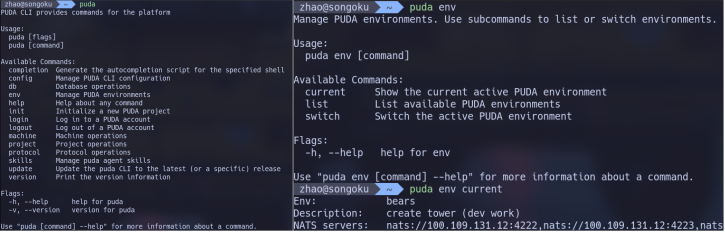
The PUDA CLI (implemented in Go) exposes the capabilities programmatically that an agent would use. This means humans, scripts, and LLMs all drive the platform through the same versioned surface. There is no hidden API reserved for internal tools. To use the CLI, simply ask the agent what the PUDA CLI can do.
Progressive Discovery — The CLI tool is intentionally navigable by an AI agent without preloading long documentation. The agent can start from a top-level command, then progressively discover the next layer through the built-in help flag.
Errors as Navigation — Every error contains both "what went wrong" and tells the agent "what to do instead." The error becomes immediate context for the AI Agent to rethink its approach or loop the human in for help.
Machine Integration
Integrating a new machine into the PUDA runtime can be done in as little as 10 minutes, provided the SDK for your device is already configured with atomic commands and well-structured docstrings.
The recommended path is using our python template, which ships with all the NATS communication logic pre-wired. This lets you focus entirely on device-specific logic and connection handling, rather than the plumbing of the runtime.
Agent Integration
PUDA is headless by design — there is no bundled UI. The intended way to drive PUDA is through an AI Agent. We recommend Claude, Hermes Agent, or Cursor for finer control. Simply install the PUDA Agent Skills from pudap/skills to unlock:
- Initializing projects
- Writing protocols
- Running experiments
- Generating reports
- and more
When a human-facing view is genuinely useful sometimes, the recommended path is for the agent itself to generate a GUI dashboard — for example, using Streamlit via the PUDA CLI. Human UIs become derived artifacts of the agent-native platform, not a parallel stack to maintain.
Seamless, Scalable Deployment
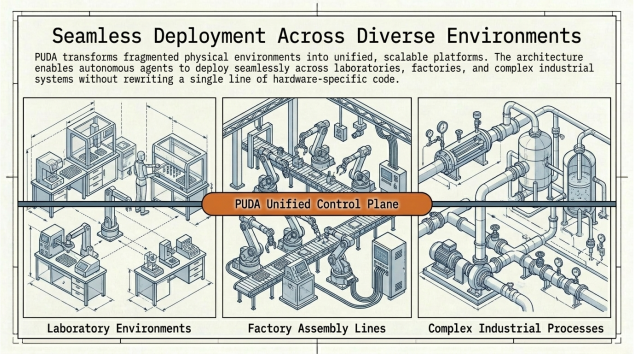
By eliminating the friction of hardware fragmentation, PUDA allows a single AI agent to seamlessly scale its operations from a benchtop experiment to a massive, heterogeneous industrial facility.
What's Coming Next
Physical AI as an infrastructure problem. PUDA gives AI agents the stable, verifiable substrate they need to operate the physical world — and gives humans a platform they can trust.
Some areas we are actively exploring:
- Broader integration across common lab and industrial equipment
- Building custom hardware with an AI-First SDK
- Distributed, multi-environment orchestration
- High-fidelity Digital Twins integration using NVIDIA Isaac Sim